
May 2026 became a period of active discussion about the role of artificial intelligence in education and translation. As part of the international cooperation between partner universities, two webinars were held focusing on the current challenges and opportunities related to the use of AI technologies in professional and academic contexts. Participants had the opportunity not only to explore modern digital tools, but also to rethink the role of humans in a world where technologies are becoming increasingly integrated into learning, communication, and translation.
On May 4, 2026, the webinar “Translation and Artificial Intelligence: New Challenges and Opportunities” took place, featuring Mary Nurminen, a lecturer at the University of Tampere (Finland), as the speaker. During the session, participants discussed how AI is transforming modern translation and the translation profession as a whole. Special attention was given to the ethical aspects of artificial intelligence, the quality and reliability of AI-generated translation, issues of bias in automated systems, and the responsible use of language data.
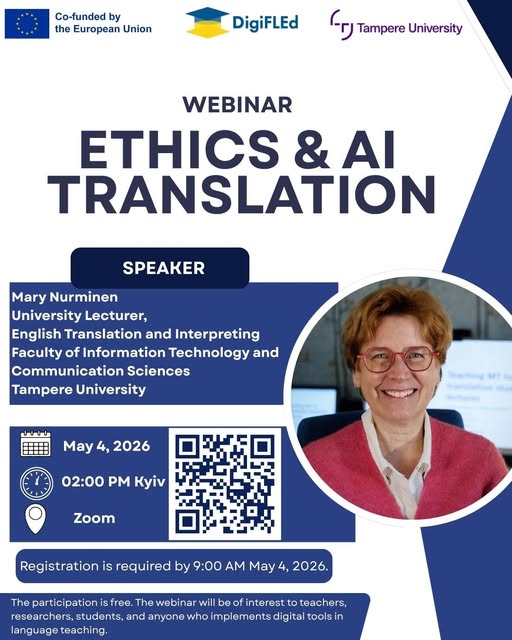
An important part of the discussion also focused on the environmental impact of AI technologies, including resource consumption, the carbon footprint of digital technologies, and their influence on the future of the profession. In addition, participants explored the new competencies required of modern translators and ways of integrating AI technologies into educational programmes.
This important conversation continued with the webinar “AI Tools for Education,” held on May 11, 2026, in cooperation with the University of Tampere (Finland). The speaker, Minas Dasygenis, Associate Professor at the Department of Electrical and Computer Engineering at the University of Western Macedonia (Greece), presented contemporary European practices in the use of AI in education and introduced participants to the results of the European AI in Education Index 2025.
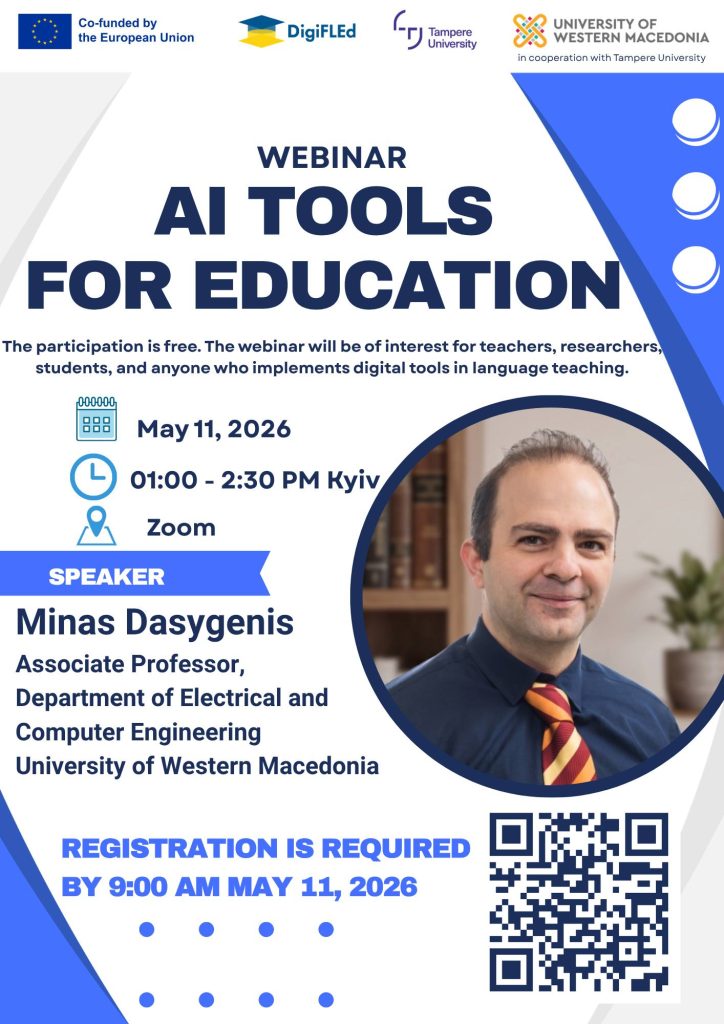
During the webinar, participants learned more about the capabilities of such tools as ChatGPT Edu, Google Gemini for Workspace, and Microsoft Copilot. Demonstrations showed how AI can support the creation of adaptive learning materials, the personalisation of educational content, the automation of assessment, and the provision of individualised feedback.
At the same time, both webinars shared a common idea: despite the rapid development of AI, the key role in the educational process and professional activity still belongs to humans. For this reason, special emphasis was placed on the Human-in-the-Loop principle, which highlights the importance of critical thinking, ethical responsibility, and the active involvement of both teachers and students in the use of digital technologies.
Participants actively engaged in discussions, asked questions, and shared their own perspectives on how AI is already reshaping educational environments and professional practice today. The events became an important platform for international academic dialogue, the exchange of experience, and reflection on the future of education and translation in the age of artificial intelligence.